How To Avoid Viruses On Social Media by James Brack

Written By M. Anandhan Mudhaliyar on Saturday, June 25, 2011 | 5:18 AM

Saturday, June 25, 2011


Online thieves and scammers are increasingly using social media to scam and hustle people out of private information and even money. This is due to people’s trust in links posted by their friends – but it has now started to filter through to people that there is a spam danger with links posted by friends.

Here are the Top 10 Basic Tips to Stay Spam and Malware Free on Social Networking Websites:


Follow me @ Twitter | Facebook | Linkedin | Digg

  • Be 100% sure that links are going to respectable websites by hovering over the link to check the web address.
  • You might receive emails asking for your log-in details – but don’t enter your Facebook login anywhere other than Facebook.com.
  • Use numbers and characters in passwords and don’t use words.  It is also recommended to change your password regularly.
  • Ensure anti-virus software is installed. Run a scan every couple of days and keep it updated with the latest updates.
  • Remove cookies.
  • Don’t add people on Facebook that you don’t know – as scammers use fake profiles to spy on you. Unfollow people on Twitter if their tweets look “unhuman”.
  • Using Wi-fi can be very spammy, as the security isn’t quite to the same level as a traditional connection. Don’t click on links in your inbox or in text messages you have received.
  • Videos that claim to show the body of Osama Bin Laden or ‘My Ex-Girlfriend Cheated on me… Here is my revenge!’ posts are spam. Don’t click on them and delete immediately. There are lots of variables of these types of scams – so always do the “hover test” to see where the link goes.
  • Remove spam and report suspicious looking links/posts.
  • Browse the security sections, such as http://twitter.com/about/security and http://www.facebook.com/security, just to keep you up-to-date and aware of things to avoid.

If you have clicked on a link that you think is malware, then immediately change your password, delete the post/uninstall the app, tell the social media website that you suspect that a post is spam, and run a full virus scan on your computer.

This guest post was written by James Brack

James Brack is a regular contributor to blogs on the topic of search engine optimization, social media security, and computer and mobile forensics

This Post was written by James Brack for http://netlz1.wordpress.com
Read More | comments (2)

Components of a Quality Links - Link Building

Written By M. Anandhan Mudhaliyar on Wednesday, June 15, 2011 | 3:40 AM

Wednesday, June 15, 2011


There are Seven Primary Components That Define Valuable Link:
  • Relevance: valuable links are relevant to your market, industry or community. Valuable link sources are within your neighborhood on the web and provide you with accurate co-citation.
  • Context: valuable links are contextual and come from sources with keyword-focused pages. How do you know if a page is keyword-focused? Well, does it rank? In most competitive markets, pages that rank well - and hold their rankings - are semantically well-optimized and have plenty of descriptive text on the page. You want your link surrounded by that keyword-themed content.
  • Difficulty: in general, valuable links are difficult to obtain. There is an associated cost: whether it’s in the investment of the link itself (note that I’m not talking about paid links), in the content that secures the link, in the site development and design, or in the time requirement getting in front of the webmaster. Valuable links are not inexpensive to secure, and they’re not easy to secure. The most valuable links come from sources where your competitors are unlikely to get the same link.
  • Humanity: valuable links require a human element to obtain. We all like direct link sources, but quite often the most high-value backlinks come from sources that have a human being in control of the website. You are picking up the phone and calling a webmaster, or emailing a contact person, or networking with someone in charge of an influential site or blog at a conference. There is almost always a human being in charge of creating links on the pages you want to target.
  • Credibility: a quality link comes from a credible source. Credible link sources elevate the perceived credibility of the site they’re linking to because they’re already trusted sources.
  • Authority: working alongside the credibility quotient is authority. High quality links come from authoritative sources, either in your niche or in the wide environment of the web.
  • Investment: valuable links require an investment of some sort. This factor goes hand-in-hand with the Difficulty factor. There’s an associated cost involved, whether in the development of a targeted piece of content or survey, in the purchase of the link, in the design and launch of the site, or simply in the time required to influence the influencers.
Read More | comments (2)

Ultimate FireFox Setup for SEOs

Written By M. Anandhan Mudhaliyar on Sunday, June 12, 2011 | 5:08 AM

Sunday, June 12, 2011

The beauty of FireFox is the fact that you can install extensions to adjust it to your needs... As an SEO, an SEO-tuned FireFox is an important tool in my job.
In this post I reveal, which FireFox extensions should I use.

SEO FireFox Extensions

If you install the following FireFox plugins, you will be able to understand the strength of each website you visit and you will be armed to submit content across your social networks.
  • SEObook SEO Toolbar - Pulls in lots of relevant SEO data to give a quick view of the competitive landscape.
  • SEOmoz Toolbar - Shows mozRank, mozTrust, Domain mozRank, Domain mozTrust and PageRank.
  • SEOquake Toolbar - Similar to SEObook SEO Toolbar but with a few additional and important tools.
  • Wordtracker SEO Blogger - Keyword research tool powered by Wordtracker.
  • TwitterFox - Post to multiple Twitter accounts in FireFox.
  • UrlbarExt - URL shortener. Supports Cligs API so you can track your click stats.
  • Firebug - Web dev tool for editing CSS, HTML, and JavaScript.
  • Cookie Swap - Swap cache in browser, especially useful for using multiple Google accounts.
  • Copy Plain Text - Strips out formatting of text when copied.
  • GA? - Shows which sites have Google Analytics installed
  • OnlyWire - Bookmark pages across over 20 bookmarking sites with 1 click.
  • StumbleUpon Toolbar - For submitting and stumbling content on StumbelUpon.
  • IE View - Opens current webpage in IE.
  • PDF Download - Allows you to do whatever you want with PDFs in FireFox.
  • Xmarks - Sync and Backup your FireFox bookmarks and passwords across multiple FireFox installations.

Other important SEO extensions for FireFox?

I have listed the FireFox add-ons I have installed and find useful in my work as an SEO.
Are there any FireFox extensions you find particularly useful?

Thanks to David Towers
Content Cource: http://www.goodwebpractices.com
Read More | comments (1)

Three Primary Goals In Social Media

Written By M. Anandhan Mudhaliyar on Monday, May 30, 2011 | 1:43 AM

Monday, May 30, 2011

To build a social media strategy around specific goals instead of simply launching a presence because "everyone else is doing it." Today, I'm going to map out the three primary goals most social media outreach campaigns fall into. If you're still trying to figure out how and why to get involved in social media outreach, consider these three categories and ask yourself how they might apply to your business. 

Three Primary Social Media Goals:

When we look at online marketing, there are three broad categories into which nearly all social media related goals can fall. They are usually either aimed at:
 
          
          1. Building/Strengthening the Brand   
          2. Driving Conversions   
          3. Increasing/Monitoring the Presence
     Starting at this broad level and thinking about the goals you have for your business can help you begin to write up a list of realistic ways in which social media might help you reach those goals.

    Let's take a closer look at these three areas and how they might apply to your social media optimization efforts.

    Goal #1: Build the Brand:

    When it comes to building and reinforcing your brand, social media is one of the most powerful marketing tools available. It gives you the strongest and broadest opportunity to both find your target audience and to engage in conversation with them.

    These days, you have no choice but to differentiate yourself from your competitors unless you have an exclusive product. Otherwise, you're forced into the unwinnable battle of competing for the lowest prices and the fastest shipping.

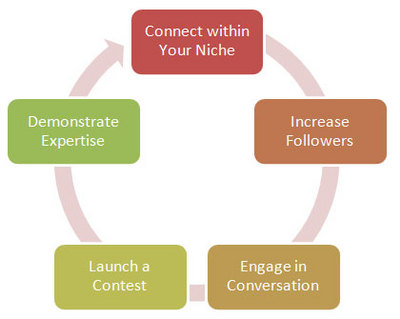
    Think about the things that make your company different from your competitors; your unique value proposition. This is the thing you want to use social media to built awareness of. If you're a service professional, target a specific niche and build a blogging and Twitter strategy around that.

    Demonstrate your expertise in working with a certain type of client and then seek out those types of clients to have conversation with. Look for new ways to connect with them and encourage your current clients to socially share your articles with their networks.

    Goal #2: Drive Conversions

    One of smartest reasons to use social media is for the potential boost it can have to your conversion efforts. Whether you're looking to drive sales, increase leads or simply drive people to action, conversions are an easily traceable goal in the realm of social media.

    Sit down and write out a list of all the potential actions someone might take while engaging with your company's web site or while interacting online.

    Obvious options like buying your products or becoming a lead spring to mind, but don't forget about other valuable actions like subscribing to your newsletter, retweeting a blog post or downloading a white paper.

    Read over your list and think about the different ways you might be able to use social media to increase conversions for each item. Often times, this is the best way to start planning your social media efforts.

    Goal #3: Increase Presence

    Finally, we come to the goal most often associated with social media outreach efforts; increasing the conversation about your brand. After all, social media is all about the conversation. It's about the only space in the world where consumers talk to each other and to companies in an environment that can be tracked, sorted and followed-up with. This makes social media a prime outlet for PR driven companies who want to know what customers are saying about them.

    Setting up even a baseline of social media monitoring can go a long way toward helping you follow these conversations. Whether you're launching new product and aiming to get people buzz about it or trying to reach out to a new target audience to share information about one of your best selling services, it's all traceable.

    When it comes to the conversation people might be having about you online, ask yourself a few questions.

        * Who do you want to hear talking?
        * What do you want them to be saying?
        * Who do you want them to say it to?

    These are your starting points for setting up key goals within the realm of increasing your presence.

    You've Set Your Stage, Now Start Building a Plan

    Looking at your business with each of the above goals in mind helps you set the stage for your social media efforts. This post isn't aimed at telling you what to do, I'm simply trying to get you to figure out why you want (and need) to do it.

    If you're small business looking to take your social media efforts up a notch (or maybe even just get started,) take the time to define at least two goals from the categories above. Once you've identified your desired outcome, you'll be a lot more ready to start mapping out the path to get there.

    Read More | comments

    Get Traffic Easily For Your Websites

    Written By M. Anandhan Mudhaliyar on Wednesday, May 25, 2011 | 2:06 AM

    Wednesday, May 25, 2011

    Getting traffic is one of the most important tasks for every webmaster. On the other hand, you can not get traffic once and then just reap the benefits. Getting traffic is a continuous and constantly has to be done, if you want to get traffic and keep it. Here are some ways to get traffic for free:

    Optimize Your Site For Search Engines: Search engines have always been an important tool to get traffic for free. Therefore, you must do your homework, and optimize your site so it ranks well for targeted keywords. SEO is still the most effective way to get traffic for free, and you really have to invest time and effort optimizing your site. SEO is not that hard, and if you want access to it in a nutshell our SEO Tutorial. If you're too busy that you can begin a 15-minute SEO article.
     
    Frequently Update Contents For Your Site: If you expect some shocking secrets revealed, might be a little disappointed. One of the first steps to get free traffic is trivial but essential - get great content and update it frequently. In terms of SEO, content is king. If the content is good and is updated frequently not only build a loyal following of repeat visitors who come often to see what is new, but also search engines love your site.
     
    Enjoy with Social Bookmarking Sites: Social bookmarking sites (especially the most popular of them) are another powerful way to get traffic for free. If you want to learn how, see How to get traffic from social bookmarking sites section, which explains what to do if you want to get free traffic from sites like Digg, Delicious, etc.
     
    Use Twitter and Facebook Sites: Social networking is also a way to get traffic for free. If they are popular networks like Twitter and Facebook, the traffic you get from there can easily exceed the traffic of Google and other search engines. It is true that building a network of followers on Twitter and Facebook followers’ goal requires time and effort, but overall the result is worth it.
     
    Links From Other Related Sites in Your Niche: another way to get traffic without any other websites in your niche. As links to other sites in your niche is also good for SEO, especially if you can not reach the famous links without nofollow. But even if the nofollow links (i.e., they are useless SEO), which still help to get traffic to your website. If you can put a link to your site in a prominent position in the bustling traffic, you get thousands of hits a link on your own. If you need a list of sites in your niche where you can get back, check to reverse the instrument builder. But beware, if you exchange links, links to bad neighbors because you can do a lot of damage.
     
    Always Use Opportunity To Promote Your Site For Free: Free promotions are always welcome, do not forget it. There are several ways to promote your site for free and some of the most popular include free classifieds, submissions to directories, inclusion in the various lists, etc. It is true that all free ways to promote your site works fine, but if selecting the right place to promote your site for free, can also cause tons of traffic.
     
    Creating Free Product or Service: The more traffic comes from content you offer something useful. There are many types of useful content, you can create and depend largely on the niche of your site. You can have articles with lots of tips and tricks in the short term, but one of the most effective ways to get traffic is to create a free product or service. When that product or service is very popular and people start to visit your site, it is likely that other sections of the site visit as well.
     
    Use Viral Content: Products and free services are great for getting free traffic to your website and one of the best varieties of this aspect, the viral content. Viral content called because it distributes as a virus - that is, when users like your content they send to their friends, post it in different places, and promoting free in many different ways. Viral content distributed on its own, and your only task is to create and send a few popular sites. After users download and distribute for you. Viral content can be a hot video or presentation, but it can also be a good story or an old photo.
     
    Offline Promotions: Offline campaign is often overlooked, but it is also a way to get traffic for free. Yes, computers are everywhere and many people spend more time than offline, but life has not moved entirely online. Offline promotion is also very strong, and if you know how to use it, it can also bring you many visitors. Some of the traditional offline ways to promote your site includes the printing of its URL on your business cards and souvenirs or stick it on your company car. You can also start selling T-shirts and other products with your logo and this way of making your brand more popular.
     
    Include your URL in your signature: URL in the signature of the forum is also a way to get traffic for free. There are forums that receive millions of visitors a day and if you are a user on a popular forum, you can use to get traffic to your site. By posting in the forums and people like your posts, which tend to click on the link to your website in my signature for more information about you? In rare cases, may be able to send a deep link (i.e., a link to an internal page of the site) instead of a link to your page and also a way to draw attention to a particular page. Unfortunately, deep links are rarely allowed.
      Get free traffic is a big topic and it is not possible to list all means. However, if you know the most important ways - that's how we have discussed in this article and are correctly applied, ensures that you will be able to get lots of traffic.

      Thanks for Reading…
      Read More | comments (5)

      SEO Techniques: White Hat v/s Black Hat SEO

      Written By M. Anandhan Mudhaliyar on Sunday, May 22, 2011 | 11:45 PM

      Sunday, May 22, 2011


      SEO techniques can be classified into two broad categories: techniques that search engines recommend as part of good design, and techniques that search engines do not approve. Search engines attempt to minimize the effect of the latter, including spamdexing. Some industry commentators have classified these methods, and practitioners who employ them, either white hat SEO or black hat SEO. White hats tend to produce results that last a long time, whereas black hats anticipate that their sites can be banned temporarily or permanently once the search engines discover what they do.

      An SEO technique is considered White Hat SEO, which is consistent with the guidelines of search engines and involves no deception. We can say that SEO is a legal white hat. Since the search engine guidelines are not written as a series of rules or commandments, this is an important distinction to note. White Hat SEO is not just about following guidelines, but aims to ensure that the contents of an index of search engines and subsequently ranks is the same content a user will see.

      White hat advice is generally summed to create content for users, not for search engines, and then make it easy for content that robots, rather than trying to trick the algorithm it uses. White hat SEO is in many ways similar to web development that promotes accessibility, although the two are not identical.

      Black Hat SEO attempts to improve rankings in ways that are frowned upon by search engines, or involve deception. One black hat technique uses text that is hidden, or colored text similar to background invisible div, or positioned off screen. Another method gives a different page, depending on whether the page is called human visitor or a search engine, a technique known as "cloaking an invisible iframe, is yet another black hat SEO techniques, you can see where the page is not necessarily a company that hosted the site. People create these types of pages, so you can download the software on your computer in the background without your knowledge.

      Search engines may penalize sites they discover with black hat methods, either by reducing their classification or delete their listings from their databases altogether. Such sanctions may be applied automatically by the algorithms of the search engine or a manual site review. Infamous examples include the February 2006 Google removal of both BMW Germany and Ricoh Germany the use of deceptive practices and the elimination of the April 2006 PPC agency BigMouthMedia. All three companies are quickly forgiven, however fixed the offending pages and return to the list of Google.

      Many web applications that use back-end systems which dynamically change the page's content (both visible and metadata such as page title or keywords meta) and the aim is to increase "the importance of search engines is based on visitors recently was the original page. This dynamic optimization and search engine optimization process can be (and is) wrong criminals in the past. Exploitation of web applications that dynamically change from being poisoned.

      Content Source: http://www.webconfs.com
      Read More | comments (4)

      High PR Dofollow Social Bookmarking Sites

      Written By M. Anandhan Mudhaliyar on Thursday, May 19, 2011 | 10:41 PM

      Thursday, May 19, 2011

      Read More | comments (5)

      Our Sponsors

      Promote Your BlogAnandhan Mudhaliyar - Find me on Bloggers.comAnandhan Mudhaliyar: SEO Tips, Tricks, Latest SEO Techniquesadd siteRSS SearchMy Zimbio Ping your blog, website, or RSS feed for FreeMy Ping in TotalPing.comGet Chitika Premium
       
      Copyright © 2011. Latest SEO Tricks . All Rights Reserved.
      Company Info | Contact Us | Privacy policy | Term of use | +Anand Mudaliar | Advertise with Us | Site map
      Template modify by Creating Website. Inspired from Maskolisfree download all